



01 · The field
What zones does the Yu-Gi-Oh! field have?
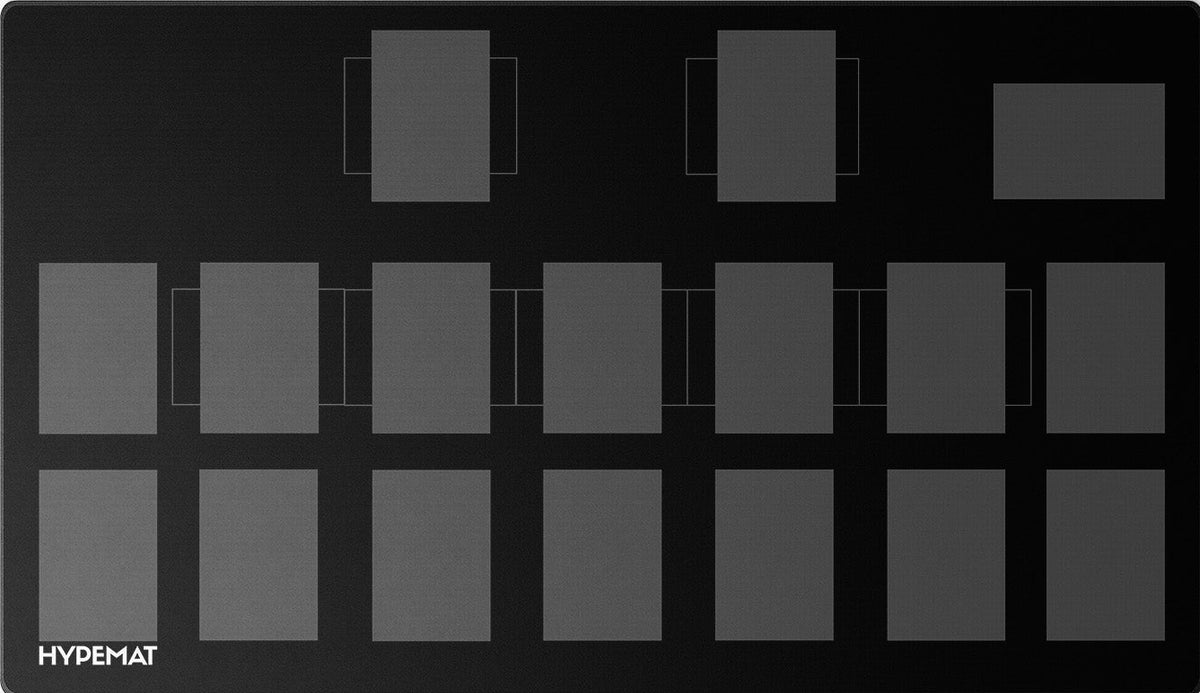
The Yu-Gi-Oh! field has two rows of zones for each player: 5 Main Monster Zones at the front and 5 Spell & Trap Zones behind them. From your side, the Field Zone and Extra Deck are on the left, the Graveyard and Deck on the right. Between the two players sit 2 Extra Monster Zones that you share. If you place a Pendulum Monster in your leftmost or rightmost Spell & Trap Zone, that zone becomes a Pendulum Zone.
Main zones
- Main Monster Zones (5)Your monsters go here, face-up or face-down.
- Spell & Trap Zones (5)For Spell and Trap Cards, activated face-up or Set face-down.
- GraveyardDestroyed, discarded and used cards, face-up.
- DeckYour Main Deck of 40 to 60 cards, face-down. You draw from here.
Special zones
- Extra Monster Zones (2)In the middle and shared. Each player normally uses only one.
- Pendulum Zones (2)Your leftmost and rightmost Spell & Trap Zones, once a Pendulum Monster is placed there.
- Field ZoneOne per player, only for Field Spell Cards.
- Extra DeckUp to 15 Fusion, Synchro, Xyz and Link Monsters, face-down, plus face-up Pendulum Monsters.
Only on the mat
- Storage area (not an official zone)An extra area on our Full Zone mat, for example for banished cards.
Markers 1 and 2 sit on the middle zone of each row of five and stand for all five.
02 · Overview
What types of Summons are there in Yu-Gi-Oh!?
In Yu-Gi-Oh!, there are ten ways to bring a monster to the field: a Normal, Tribute or Flip Summon, a Special Summon through an effect, and six special kinds of Special Summon: Ritual, Fusion, Synchro, Xyz, Pendulum and Link. You can also Set a monster, which officially is not a Summon. Konami counts the Tribute Summon as a form of Normal Summon.
| Summon | From | Requirement | How often |
|---|---|---|---|
| From the hand and the field | |||
| Normal Summon (yellow or orange frame) | Hand | Level 1–4, no Tribute | Once per turn |
| Tribute Summon (yellow or orange frame) | Hand | Level 5–6: 1 Tribute · Level 7 or higher: 2 Tributes | Counts as a Normal Summon |
| Set (not a Summon) | Hand | Face-down in Defense Position, Tribute needed from Level 5 | Shares the same limit |
| Flip Summon | Field | Face-down monster, not Set this turn | No limit |
| Special Summon | Depends on the effect | Card effect or the monster’s own condition | No limit |
| Ritual Summon (blue frame) | Hand | Ritual Spell + Tributes with a matching Level total | No limit |
| With the Extra Deck | |||
| Fusion Summon (purple frame) | Extra Deck | E.g. “Polymerization” + Fusion Materials | No limit |
| Synchro Summon (white frame) | Extra Deck | 1 Tuner + non-Tuners, exact Level total | No limit |
| Xyz Summon (black frame) | Extra Deck | 2+ face-up monsters with the same Level | No limit |
| Pendulum Summon (frame: monster type color on top, green below) | Hand + face-up from the Extra Deck | Both Pendulum Zones filled, Level between the Pendulum Scales | Once per turn |
| Link Summon (dark blue frame) | Extra Deck | Materials as listed on the card, total = Link Rating (a Link Monster counts as 1 or as its Link Rating) | No limit |
Color swatch = card frame. Rules: Advanced Format (standard), April 2020 revision. In Genesys, there are no Pendulum or Link Summons.
03 · Summons
How does each type of Summon work in Yu-Gi-Oh!?
Each type of Summon in Yu-Gi-Oh! brings a monster to the field in its own way. Normal and Tribute Summons come from the hand, and a Flip Summon turns a face-down monster face-up. Fusion, Synchro, Xyz and Link Summons bring monsters out of the Extra Deck and use up materials to do so. A Ritual Summon needs a Spell Card, a Pendulum Summon needs two filled Pendulum Zones.
Normal & Tribute Summon
You play a monster from your hand in face-up Attack Position, once per turn. Level 1–4 needs no Tribute. From Level 5, you send your own monsters from the field to the Graveyard: Level 5–6 costs 1 Tribute, Level 7 or higher costs 2.
Set & Flip Summon
To Set a monster, you place it face-down in Defense Position. That does not count as a Summon, but it uses up your Normal Summon limit. From your next turn at the earliest, you can Flip Summon it face-up, and its “FLIP:” effects activate.
Special Summon
The umbrella term for every Summon that is not a Normal, Tribute or Flip Summon. Special Summons don’t use up your Normal Summon. Some work through a card effect such as “Monster Reborn”, others through the monster’s own condition, as with “Cyber Dragon”.
Ritual Summon
Ritual Monsters go in your Main Deck and are Summoned from your hand. You activate the matching Ritual Spell Card and Tribute monsters. Their Levels must add up to the Ritual Monster’s Level. The Ritual Spell Card tells you whether the total must match exactly or can be higher.
Fusion Summon
You activate a card like “Polymerization” and send the Fusion Materials listed on the Fusion Monster to the Graveyard. The Fusion Monster comes from the Extra Deck into a free Main Monster Zone or into the Extra Monster Zone. Fusions have been around since the very first TCG set.
Synchro Summon
One face-up Tuner and one or more face-up non-Tuner monsters go to the Graveyard. Their Levels must add up to exactly the Synchro Monster’s Level, for example a Level 3 Tuner plus a Level 5 monster for a Level 8 Synchro Monster.
Xyz Summon
You stack two or more face-up monsters with the same Level and place the Xyz Monster on top. Xyz Monsters have a Rank instead of a Level. The Xyz Materials stay underneath and are “detached” for effects.
Pendulum Summon
With both Pendulum Zones filled, you Summon as many monsters as you like whose Levels are between the two Pendulum Scales. With Scales 1 and 8, that means Level 2 to 7, from your hand and face-up from your Extra Deck.
Link Summon
You send face-up monsters that match the recipe on the card to the Graveyard as Link Materials. Together they make up the Link Rating: each monster counts as 1, and a Link Monster counts as either 1 or its Link Rating. Link Monsters have no Level, no Rank and no DEF, and they are always in Attack Position.
04 · Zone rule
When does a monster have to go to the Extra Monster Zone?
In Yu-Gi-Oh!, only Link Monsters and face-up Pendulum Monsters Summoned from the Extra Deck still have to go to the Extra Monster Zone. Alternatively, they can go to a zone that a Link Arrow points to. Since Konami’s April 2020 rules revision, Fusion, Synchro and Xyz Monsters can go to any free Main Monster Zone. Konami has not changed the zone rule since then (checked in September 2026).
“Fusion, Synchro, and Xyz Monsters can be first Summoned from the Extra Deck to any of your Main Monster Zones.”
From 2017 to 2020, the restriction applied to all Extra Deck monsters. Link Arrows point to neighboring monster zones. If an arrow points to one of your Main Monster Zones, you can also Summon a Link Monster or a face-up Pendulum Monster from the Extra Deck there. If you bring an Extra Deck monster back from the Graveyard or from being banished, it goes to a Main Monster Zone.

Printed near Hamburg
Playmat with zones
Every zone.
Your artwork.
On a 3 mm mat.
- Half Zone, Full Zone or no zones at all
- Upload your artwork and position it in the live preview
- Optional graphic check: we check sharpness and resolution manually
- 610 × 355 mm, 3 mm, 4K printing
Prices in your currency on the product page · usually with you in 2–5 business days (Germany)
4.8/5 from 574 reviews (Judge.me, as of 4 Oct 2026)
05 · FAQ
Frequently asked questions about the Yu-Gi-Oh! field
Each player has 5 Main Monster Zones. On top of that, there are 2 Extra Monster Zones in the middle of the field that both players share. Normally, each player can use only one of them.
The Extra Monster Zone holds monsters from the Extra Deck. Since Konami’s April 2020 revision, only Link Monsters and face-up Pendulum Monsters from the Extra Deck have to go there, or alternatively to a zone that a Link Arrow points to. Fusion, Synchro and Xyz Monsters can go to any Main Monster Zone or to the Extra Monster Zone.
Since 2017, the Pendulum Zones have been your leftmost and rightmost Spell & Trap Zones. When a Pendulum Monster is placed there as a Spell Card, that zone counts as a Pendulum Zone. From 2014 to 2017, they were two separate zones on the outer edges: on the left between the Field Zone and the Extra Deck, on the right between the Graveyard and the Deck.
A Yu-Gi-Oh! Main Deck has 40 to 60 cards. On top of that, you can have up to 15 cards in your Extra Deck and up to 15 in your Side Deck. You can play no more than 3 copies of any card across your Main, Extra and Side Deck combined; the Forbidden & Limited List can restrict this further.
No. According to Konami’s rulebook, placing a monster face-down in Defense Position is not a Summon. But a Set uses up the same limit as a Normal Summon: each turn, you can do either one Normal Summon or one Set.
One Normal or Tribute Summon (or one Set) per turn, plus as many Flip Summons and Special Summons as you like. The exception is the Pendulum Summon: you can only do it once per turn, but it brings any number of monsters to the field at once.
No, the zones apply on a bare table too. Printed zones do help you learn and keep the field tidy. Yu-Gi-Oh! playmats with zones come as Half Zone or Full Zone, and if you only want your artwork, choose the layout without zones.
The standard size for a Yu-Gi-Oh! playmat is 610 × 355 mm, about 24 × 14 inches. It fits one player’s full side of the field, and sleeved cards sit on it comfortably. Hypemat mats are exactly this size and 3 mm thick.
Sources and rules version
This guide follows Konami’s official rules for the Advanced Format (standard): Master Rule, April 2020 revision (fully in effect in the TCG since the 2021 Rules Update). Checked on 26 Sep 2026.
- Konami: Beginner’s Guide 2017 (PDF) (opens in a new tab) – field, Extra Monster Zones, Link Summon
- Konami: 2021 Rules Update (opens in a new tab) – zone rule for Extra Deck monsters
- Konami: Official Rulebook 9.0 (opens in a new tab) – Normal, Tribute, Flip and Special Summons, Deck sizes
- Konami: Genesys (opens in a new tab) – format rules
- Year each type of Summon was introduced: set lists on Yugipedia